Office Clearance in Shepherds Bush
We provide office clearance in Shepherds Bush for businesses that need desks, chairs, storage units, filing, IT equipment and general workplace items removed in an organised way. The service is designed for offices that are relocating, refurbishing, downsizing or simply making space for a better layout. We focus on practical removal work that helps you clear rooms efficiently while keeping the process straightforward for managers, landlords and agents who need the site handed back ready for its next use.
Our office clearance work covers partial and full clearances, so you can ask for help with a single room, a floor of workstations or a whole premises. We can also deal with mixed contents where furniture, electronics, archive material and loose office items need to be separated before removal. Careful sorting matters because not everything from an office should be handled in the same way, and a well-planned clearance helps keep useful items apart from those set aside for disposal or recycling.
To arrange the right scope, it helps to think through access, floor levels, lift use and the type of contents that need moving. If you have a deadline for a handover or need the clearance staged across more than one visit, say so early so the work can be planned properly. If you are ready to compare options, ask for a quotation and outline the items you want cleared.
What an Office Clearance Can Include
Office clearance is rarely just a matter of taking away a few unwanted pieces of furniture. Many workspaces contain a mix of meeting tables, pedestal drawers, reception seating, shelves, kitchen items and boxed paperwork, all of which may need different handling. We can remove items from open-plan areas, private offices, storage rooms and communal spaces, then separate what is reusable from what should be treated as waste. That creates a more ordered result and makes it easier for you to see what remains on site.
When a workplace has been occupied for years, clearances often reveal items tucked into cupboards, under desks or in corners that are easy to overlook. Our approach is to work through the space systematically so the important areas are not missed. Where useful, we can remove light fixtures of office furniture, dismantled items and mixed loose contents as part of the same project. If you need to keep some items in place, make that clear before the visit so the team can work around them.
Furniture and fitted items
Most office clearances begin with the largest items because they set the pace of the job. Desks, cabinets, shelves, tables and chairs usually need to be moved in a controlled order so access routes stay clear. Some pieces can be taken away intact, while others may need partial dismantling before removal. Furniture clearance may be useful where the job centres on desks, seating and storage rather than a broader workplace clear-out.
Planning a Clear and Efficient Clearance
Good planning helps the clearance move smoothly from one area to the next. A concise list of what is staying and what is going can prevent delays on the day, especially in occupied buildings where shared corridors or reception spaces must remain usable. We recommend identifying any items that contain records, cables, keys or personal property before the clearance begins, because those items often need to be checked or separated before anything is removed from the premises.
For larger office clearances, access details can make a real difference to how the work is organised. Let us know about parking restrictions, loading points, lift size, narrow stairways or security procedures so the removal plan matches the building. If the office is on a tight schedule, it can also help to group similar items together beforehand. Simple preparation can reduce confusion and allows the removal work to progress in a clean sequence rather than stopping to sort everything at the last minute.
When partial clearance is the better fit
Not every workplace needs a full emptying service. Sometimes the goal is to remove obsolete furniture, archive boxes, excess stock or a few rooms of redundant equipment so the remaining office can carry on operating. Partial clearance is often a sensible option where a business is staying in place but reorganising its layout. If the job includes other items beyond standard office contents, business waste removal may be relevant as part of the wider plan.
Items Commonly Removed From Offices
Office contents vary from one site to another, but many clearances include a familiar mix of work furniture and operational items. We can remove desks, chairs, meeting tables, filing cabinets, shelving, monitor stands and other loose office furnishings, along with smaller pieces that tend to gather in drawers and cupboards. Where the workspace includes reception areas or breakout rooms, those can be cleared as part of the same service so the whole property is dealt with consistently.
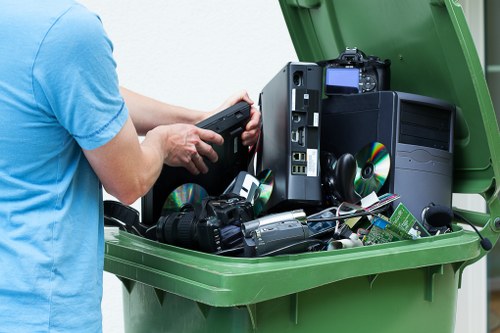
Electronics are another common part of an office clearance. Computers, printers, scanners, telephones, screens and accessory items may all be present, and these are best handled with care so they can be separated from general furniture. The same applies to cables, docking stations, keyboards and peripheral equipment that build up over time. If you are dealing with a storage room or server-adjacent space, describe the contents carefully so the clearance is planned around what is actually there rather than a generic office layout.
Many businesses also want help removing boxed files, archived records, stationery, sample materials and other stored items. These can make a room look fuller than it is and often take more time than expected to sort. When items are still in use, tell us in advance so they can be left alone. Where the main need is to clear a storage-heavy room, home clearance is not the right comparison, but it shows the kind of broader removal work that can be organised across mixed contents.
Handling Furniture, Fixtures and Mixed Contents

Some office clearances involve straightforward removals, while others require more attention to the shape, weight or condition of the contents. Large cupboards may need to be emptied before moving, conference tables may require partial dismantling, and older office pieces can be awkward to carry through shared spaces. We take a practical approach to these jobs so the work is carried out with order and care rather than rushed from one room to another.
Where a workplace has been configured over a long period, mixed contents can become especially layered. You may find furniture beside packaging, display items, obsolete technology and general stored materials. A sensible clearance separates these categories rather than treating everything as one pile. That helps the site look tidier sooner and makes it easier to understand what remains. For businesses with a strong recycling focus, recycling and sustainability can be an important consideration alongside the clearance itself.
It is also common for offices to contain items that are no longer part of day-to-day work but still need checking before removal. Examples include spare chairs, old display boards, presentation equipment, spare filing units and surplus shelving. If there are items that must not be taken, label them clearly or keep them in a separate area. A well-marked workspace supports quicker removal and helps avoid confusion when several rooms are being cleared at the same time.
Office Clearance for Moves, Refits and End of Tenancy Work
Office clearance often sits alongside a move, refurbishment or lease end, which means timing and sequence matter as much as the items themselves. If furniture is being removed before contractors arrive, the clearance may need to happen in stages. If the office is being handed back, the remaining contents usually need to be assessed carefully so nothing is left behind by mistake. Clear instructions about what should stay, what should go and what needs to be checked can make the process much easier.
Where several teams are involved, the clearance may need to fit around decorators, fitters, cleaners or building managers. In those cases, the best plan is often to clear the largest items first and leave the final tidy-up until the space is otherwise ready. That avoids unnecessary double handling and reduces the chance of items being moved more than once. If you need a removal schedule that ties in with a tenancy deadline, ask for a quotation and describe the order in which the space needs to be emptied.
Why clearances are often staged
Staging the work can help when different parts of the office contain different types of contents. A reception area may be simple to empty, while back-office rooms, storage cupboards or meeting suites can take longer because they contain a mixture of items. Breaking the job into sections allows each area to be dealt with properly. Office clearance is therefore often most effective when the scope is described room by room rather than only as one overall request.
About Shepherds Bush
Shepherds Bush is a district in West London that sits within the London Borough of Hammersmith and Fulham, with strong transport links and a busy high-street character. The area is known for Shepherds Bush Green, an open space that has long formed a focal point in the local street pattern, and for the concentration of shopping, entertainment and residential streets around it. The district developed rapidly in the late nineteenth and early twentieth centuries as London expanded westward, and much of its built character still reflects that period of urban growth. Rows of terraced houses, mansion blocks and mixed commercial frontages give the area a varied appearance, while the older street plan continues to shape movement through the neighbourhood. Shepherds Bush Market is one of the best-known local landmarks, and its presence adds to the area’s everyday trading atmosphere. The nearby railway and Underground stations have made the district a significant interchange for visitors and commuters, which in turn has influenced the way shops, workplaces and homes are arranged close to the main roads. The area also sits near larger destinations such as White City and Hammersmith, but Shepherds Bush retains its own identity through local shopping streets, the green itself and a dense mix of housing and businesses. Cultural life is another notable feature, with the nearby Eventim Apollo and Westfield London contributing to a lively part of west London that combines retail, entertainment and residential use within a compact urban setting.
Waste, Recycling and Responsible Sorting
Office clearance is not only about removal; it also depends on how items are sorted once they leave the building. Furniture, metal components, mixed materials and electrical equipment each require appropriate handling, and separating them early can make the overall process more orderly. We aim to keep the work practical and well organised so the clearance does not leave you with a second round of sorting after the main items have gone. That matters when the site needs to be presented cleanly at the end of the job.
Where items are suitable for reuse or further processing, it helps to identify them before collection. This can include desks that are still serviceable, chairs with useful parts or storage units that are better treated separately from broken items. The exact handling depends on the contents and condition of what is being cleared, so accurate descriptions are valuable when you request a quotation. If you are dealing with a broad mix of furniture and general waste, waste removal can be a useful related service to compare.
Businesses sometimes want a clearance arranged with minimal disruption to the remaining workplace. In those cases, the work may be set up around business hours, access restrictions or sections of the office that are still in use. Tell us which rooms are active and which are vacant so the removal plan matches the building. Clear instructions reduce the chance of confusion and make it easier to focus on the items that actually need to be removed.
Clearance for Furniture, Storage and Ancillary Rooms
Office buildings often contain more than desks and chairs. Kitchens, stock cupboards, archive areas, print rooms and small storerooms can hold items that need removal at the same time as the main office furniture. These spaces are easy to overlook, yet they often contribute a large amount of the remaining clutter. A proper clearance takes the whole workplace into account so the final result is not undermined by a forgotten side room or a half-filled store.
Some office furniture also has to be moved through awkward internal routes or out of buildings where access is tighter than expected. That can affect how the work is arranged and whether certain pieces need to be dismantled before removal. If there are bulky items near door frames, stairwells or lifts, describe them in advance so there are fewer surprises on the day. For premises with a strong focus on stored stock or archive items, loft clearance may be a useful point of comparison for the careful handling of crowded storage spaces.
Where an office also contains domestic-style furnishings in a staff room, meeting area or annex, those can be removed as part of the same overall service. The key is to keep the description of the job accurate so the right labour and vehicle plan can be arranged. Ask for a quotation if you need help clearing a workplace that includes both standard office furniture and additional stored items.
Getting a Quotation for Office Clearance in Shepherds Bush

A useful quotation begins with a clear description of the office, the rooms involved and the main items to be removed. Photos can help when the contents are mixed or when access is difficult, but a written summary is also valuable because it highlights details that pictures may miss. If certain items must remain in place, say so plainly. It is also worth noting whether the clearance is for a move, a refit or a general tidy-out, because that helps define the scope more accurately.
When you are ready to make an enquiry, include the approximate volume of items, any parking or loading restrictions, and whether the premises are occupied during the work. This allows the clearance to be planned sensibly without unnecessary delays. If you need to compare the cost of different types of removal work, pricing and quotes can give you a useful starting point before you request a tailored figure for the job in hand. Ask for a quotation once you know which rooms and items are included.
For general questions about the company or the wider service range, you may also want to review the main site pages before you decide how to proceed. A good enquiry keeps the focus on what needs clearing, what should stay and when the work must happen. If you would like the office cleared in Shepherds Bush, contact us for a quotation and tell us about the space.